Why We Resist It and What It Really Does for Us
Intro
This article is for you if you resontate with:
“I understand my emotions in my head and I sometimes understand the why,
but I can’t seem to feel or move them through my body.”
Emotional awareness doesn’t automatically mean emotional expression.
In this blog, I share the education side of feeling – how it works on a brain and body level – because psychological safeness comes from clarity and understanding. This isn’t the process of feeling (that’s what we work through in sessions), but knowing the science can make it much easier to allow feelings to emerge.
Here’s why…when the mind understands the mechanics, the body feels safer to open. The two are not at odds, they are co-conspirators in the work of being human.
Thinking and Feeling

One of the first steps in emotional work is noticing the difference between thinking about your feelings and actually feeling them.
Example: You might think, “I’m sad because I miss them” (thinking), but your body might be showing hollow in the chest, subtle tightness in the throat, or tears (feeling) and inside of that, an emotional charge. In self-awareness world, we sometimes blur the line between “I know what I feel” and “I have felt it.”
How Feelings Move Through the Body
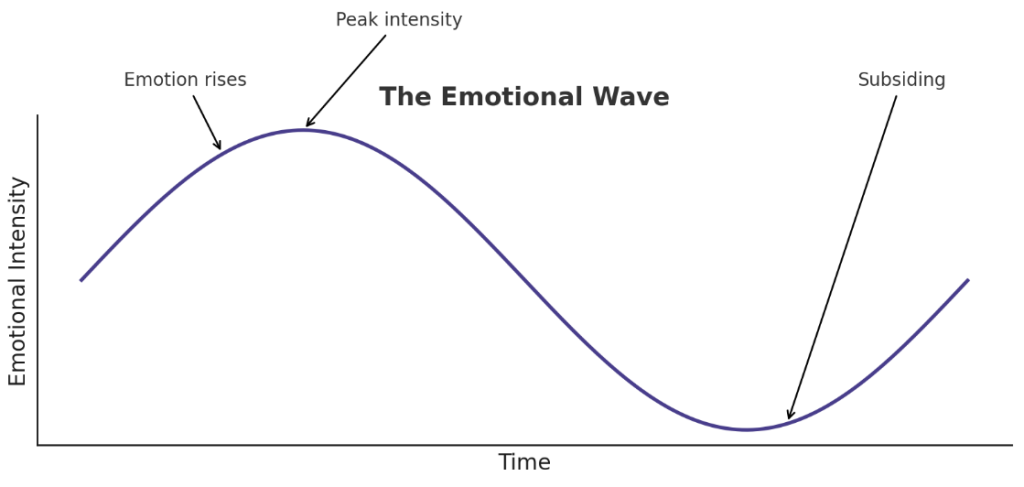
A felt emotion is not a metaphor – it is a physiological sequence. It tries to initiate -> then peak in intensity -> then subside. When it is at peak intensity, you may notice:
- Pulsations or fluttering (in the gut, heart, eyelids, nostrils, lips, jaw)
- Heat moving through the body
- Quivering or trembling
- Tears, wails, or soft sobs
- Hands reaching out for safe contact/resource
- …and more
These movements are the body’s way of completing an emotional wave.
The Brain As The Gatekeeper

Our brain is a gatekeeper; it constantly scans for safety. The brain’s primary question is not “What is true?” but “What keeps me safe?”
When an emotion tries to surface, the brain asks:
Is it safe to feel this now? (Am I under threat or needing to survive with tasks?)
Do I recognise this feeling? (Have I felt it before and survived?)
Do I know what to do with it? (Have I learned how to express and complete this safely?)
If the answer to any is “no,” the feeling:
- may be postponed, disguised, or rerouted into thought.
- for emotionally intelligent ones, the block may be subtler: an elegant reframe, an insight that names the feeling without actually meeting it.
- Sometimes, the brain will let an emotion through by linking it to a memory. This is why certain feelings are tied to memories or sudden images from the past.
The 60–90 Second Rule

When an emotion first arises, the body releases a cascade of chemical signals – a flush of hormones and neurotransmitters that create the physical sensation of that feeling.
Neuroscientist Dr. Jill Bolte Taylor famously found that this physiological wave lasts only about 60–90 seconds.
- The initial rush: When something triggers an emotion (like fear, anger, or joy), a cascade of chemicals is released in your body, and your brain circuitry responds accordingly.
- The 90-second flush: It takes approximately 90 seconds for these chemicals to be flushed out of your system and for your brain’s circuitry to reset.
- Beyond the 90 seconds: The role of thoughts: If you continue to experience the emotion beyond this initial timeframe, it’s often because your thoughts are re-stimulating that initial chemical and neural reaction. You can get caught in a “loop” by replaying the situation, dwelling on it, or adding further thoughts and judgments.
Important points:
- This rule refers to the biological lifespan of the emotion, not necessarily the entire emotional experience. Feelings, which are interpretations of emotions, can last for much longer (hours, days, or even longer) as someone continues to engage with and process those initial emotions and the thoughts associated with them.
- Emotional regulation techniques, such as mindfulness, cognitive reappraisal, and acceptance, can help break these loops and manage the duration and intensity of emotions.
This is good news: if we can stay present with the physical sensation for just a minute or so without adding mental fuel, the body naturally metabolises it. In other words, the feeling completes its cycle, and we create space for clarity, choice, and calm.
The Function of Feeling
Feeling isn’t just “being emotional”. It’s how we keep emotions from becoming trapped in the body.
When feelings are blocked for too long, they can turn into:
- Anxiety (Hyperarousal) – moving through the world with a constant sense that something’s wrong.
- Depression (Hypoarousal) – moving through the world under a weight your body can no longer hold.
What’s held in the body stays in the unconscious. Over time, this leads to:
- Body armouring – chronic tension or tightness as the body “holds in” unprocessed emotion.
- Life armouring – guarding yourself emotionally, keeping others at a distance, avoiding situations that might trigger feelings.
When we feel, we allow what was unconscious to come into conscious awareness. It moves from a silent physical burden into an integrated piece of our narrative.
Questions to Explore After Feeling

Once a wave of emotion has moved through, you can gently ask yourself:
- What was I holding in me unconsciously?
- What was the weight of that doing to me on the outside? (e.g. keeping myself overstimulated to avoid feeling it)
- What do I now realise?
- If my tears or grief or feelings had a message to leave behind, what would they want to say?
From here, you can connect the feeling to action – this is where agency comes in, a possibility for a new future:
- If it was loneliness – do I tend to unconsciously avoid new connections? Could I take one step toward belonging?
- If it was missing a time or place of belonging – what could I recreate now, in a way that honours today’s life?
- If it was missing a person – what quality of theirs could I cultivate in myself or my environment?
Why Education Matters Before Feeling
Trying to dive into emotions without understanding what’s happening can feel scary or overwhelming.
Education acts as an anchor. It tells the brain, “This is safe. I know what’s happening.”
When you understand that trembling, heat, or tears are part of the body’s natural release, you can trust the process instead of shutting it down.
Final Note
The information in this blog is here to help you feel safer approaching your emotions. But reading about emotions is different from experiencing them. The actual process of feeling is something we explore slowly, with care, in a supported space.
When you have the map, it’s easier to trust the journey.
